How to Grow Instagram for Business in 2026 (The Practical Playbook)
Growth Means Customers, Not Just Followers
Growing Instagram for a business in 2026 is a different game than growing a personal account. For a local restaurant, growth means nearby diners. For a service business, it means qualified inquiries. For a retailer, repeat customers and referrals. Follower count still has value — but only if those followers match the market you serve and take actions that matter. The playbook below is built in five stages, in order: a profile people can find, content you can sustain, discovery by the right people, conversion into conversations, and measurement of what matters.
Stage 1: Set Up a Profile That Sells Before You Post
Switch to a Business account first — it unlocks Insights analytics, contact buttons, Stories link stickers, ad capability, and Meta Business Suite. Then build the profile as a storefront:
- Name field with keywords: Instagram is a search engine now. “Bloom Bakery | Custom Cakes Chicago” gets found; “Bloom” does not.
- Bio with mission plus CTA: state what you do, who it is for, and one friction-free action — book, order, or visit. Our Instagram bio generator drafts business bios fast.
- Action buttons: call, email, directions, booking — every tap you remove between interest and contact raises conversion.
- Highlights as a mini-website: Menu, Reviews, FAQ, How to Order, Contact. New visitors should be able to buy without scrolling your grid.
Stage 2: Get Discovered by Local, Relevant People
For most small businesses, growth is local first. Tag your shop, venue, or town as the location on every post — when people tap a location, they see your content. Spend your 5 hashtags on place and service terms, not generic mega-tags. Use Collab posts with neighboring businesses and local creators to borrow relevant audiences. And treat your name field, bio, and captions as search fields: Instagram now surfaces content based on keywords in these fields, not just hashtags.
Stage 3: Content You Can Shoot in Two Hours a Week
You do not need a content team. You need about two hours a week producing three short videos and a handful of photos, filmed in one sitting, built from questions customers already ask. The content mix the best guides converge on: roughly 40% educational or helpful content, 30% product or service content, 20% behind-the-scenes or personality, and 10% direct promotional posts with clear CTAs.
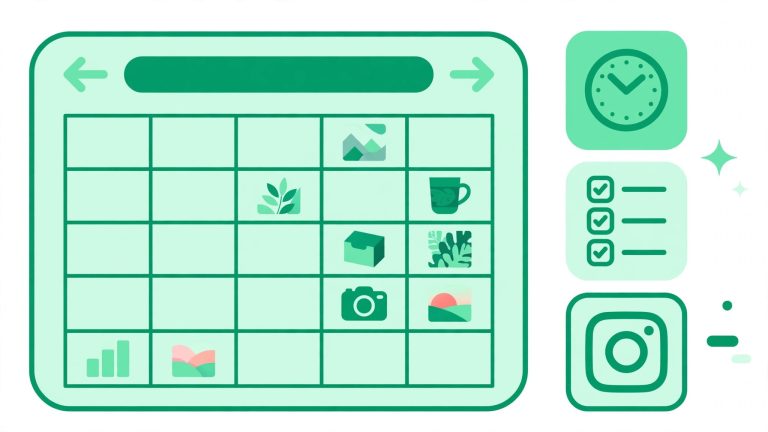
Lead with Reels for discovery — they reach non-followers far beyond what static posts manage — and use carousels for depth, since carousels earn the highest saves among people who already follow you. Post 3 to 5 times a week: benchmarks show businesses moving from 1 to 2 posts weekly to 3 to 5 roughly double their follower growth rate. Batch everything monthly and schedule with Meta’s built-in scheduler or a tool like Later or Buffer.
Stage 4: Turn Attention Into Conversations (and Bookings)
Here is where business accounts win or lose. Design every post to be saved or sent, not just liked — saves and DM shares carry far more algorithmic weight than likes. Use Stories daily (3 to 5 per day) with polls and question stickers, because replies move you up in followers’ story queues and start sales conversations. Treat DMs as your sales floor: answer fast, use saved replies for FAQs, and track how many conversations become bookings. Count DMs and comment-to-DM conversions as your real bottom line — not likes.
Stage 5: Measure Business Metrics, Not Vanity Metrics
Instagram Insights is free and covers the last 90 days. Track the numbers tied to revenue:
- Brand awareness: track reach and share rate, not follower count.
- Lead generation: track link-in-bio clicks and profile visits, not post likes.
- Community trust: track save rate and DM inquiries, not generic comments.
- Revenue: track profile conversion rate and attributed bookings, not viral views.
When the account is not producing customers, one of the five stages is broken — and it is almost never reach, the one owners blame first. Diagnose in order: can people find you, is the content consistent, is the audience local and relevant, are DMs handled, are you measuring the right things?
Using Stories and Reels Together for Business
Do not treat formats as separate channels — they are one funnel. Use Reels to get discovered by cold audiences, then use Stories to warm them up: polls, behind-the-scenes clips, and limited-time offers that turn a viewer into a DM conversation. Share every new Reel to your Stories an hour after posting for a second wave of views. Pin your three best-performing Reels to your profile so ad-driven or Explore-driven visitors immediately see proof of value. The combination of Reels reach plus Stories intimacy is what turns a business profile from a catalog into a conversation.
What to Avoid
Never buy followers or engagement, and never use growth bots. They inflate metrics fast, then leave you with suppressed reach, weak trust signals, and an audience that never converts — actively working against every lever above. The algorithm rewards relevance, not raw numbers.
The Bottom Line
Growing Instagram for business in 2026 means: a searchable, shoppable profile; local-first discovery; two hours a week of batched content led by Reels; DMs treated as a sales channel; and metrics tied to revenue. Do that consistently for 90 days and measure enquiries, not followers. For the audience-building fundamentals underneath it all, see how to get more followers on Instagram — and if you want early social proof while the system compounds, the free followers trial on our homepage gives new business profiles a credible starting base.